How Permanent Outdoor Lighting Holds Up Through Texas Weather in San Antonio
Almost nobody asks me about hail on an estimate in San Antonio. Given that Texas led the country in major hail events again last year, that surprised me at first. It turns out to be the right instinct.
The question worth asking is about heat. After handling these products and comparing them against most of the systems sold here, heat is the part of Texas weather that quietly shortens the life of a permanent light.
Heat, hail, sun, and rain each stress a different part of the system.
Heat is the part of Texas weather that matters most
San Antonio normally tops 100 degrees on 18 days a year, using the 1991 to 2020 normals from the National Centers for Environmental Information, and the average high in mid August is 97. The lights on a west-facing fascia in Stone Oak are sitting in that heat all afternoon before they ever turn on.
An LED usually does not burn out the way an old bulb does. It fades, though a diode or a driver can still fail outright. The U.S. Department of Energy's LED luminaire lifetime guide marks useful life at L70, the point where output has fallen to 70 percent of where it started, and it measures that decline at fixed case temperatures because heat is what speeds it up. The same guide is careful to say a rating on the LED package is not a rating on the whole light. Hotter diode, faster fade.
That is why the hour rating on a spec sheet is not a promise. It is a lab number. Ask which component was tested, at what temperature, and whether the number describes the diode or the complete light with its driver and housing. A 50,000-hour package rating can come up short in a soffit that has been baking since noon.
TruLight publishes a 100,000-hour rating on its diodes. Trimlight publishes 50,000. Both are component ratings, and neither one is proof of installed life in Texas. On paper ours is twice theirs. That still does not prove a two to one difference on your roofline.
Voltage plays into this too. TruLight and JellyFish publish 48-volt systems. Trimlight publishes 12 volts. At equal power, 48 volts moves a quarter of the current that 12 volts does, and less current means less heat building up in the wire on a long run. It is also why a 48-volt system needs fewer power injection points along a big roofline.
On a real install, one port on the TruLight control box carries roughly 150 to 200 feet of lights, depending on the layout. One box handles about 300 to 350 feet in total, which comes to around 400 lights. Most homes fit on one box.
TruLight does not publish an operating temperature rating for the node or the control box, so I will not quote one. What I can tell you firsthand: we have installed plenty of control boxes outdoors in Arizona, and they handle that heat. Field history is not a lab rating, but it is the evidence I have. In Texas the box usually goes on the garage wall. When someone wants the front and the back of the house lit, the attic is often the better spot.

Hail: where the track sits decides most of it
Texas earned its reputation. NOAA's Storm Prediction Center logged 902 Texas hail events with stones an inch across or larger in 2025, more than double the next state, according to the Insurance Information Institute. State Farm says it paid about $1.4 billion in Texas hail claims that year, across 95,200 claims, and that is one insurer.
San Antonio owns the worst example. On April 12, 2016, the Weather Service verified four and a half inch hail across Bexar County, and the Insurance Council of Texas put the damage near $1.4 billion, the costliest hailstorm in Texas history at the time.
So why do I say hail is the smaller worry? Because of where the light lives.
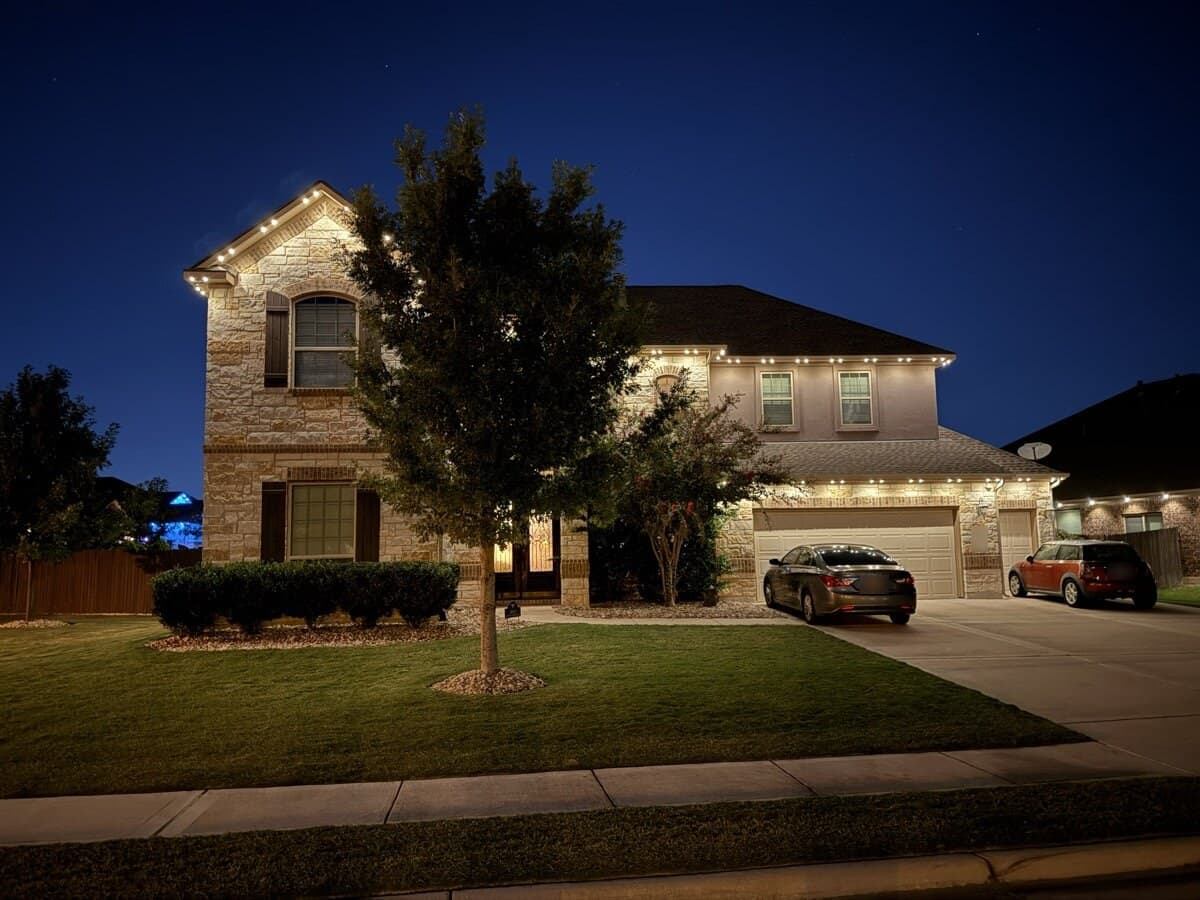
TruLight track mounts underneath the fascia or the soffit. Never on the roof, never on top of the gutter. The roof edge sits above it, so the eave gives the track some cover. Wind can still drive stones sideways, and a run on the windward side of a two-story home is more exposed than one tucked under a deep eave. We have never had a light damaged by hail. Not one. I am still not going to call it hail-proof, because nobody can promise that in Texas. I will say the placement is on your side in a way it is not for a system strapped to the top of a gutter.
The shape of the light matters as well. In a side-by-side sample comparison I put a TruLight node next to a Bosso node. Ours has a flat diffused face that sits inside the aluminum channel. Theirs has a dome that stands proud of the track. That changes how much of each node is out in the open. It is not an impact rating. I did not find one in any of the published specs I read.
Then there is the warranty, and this is the page to read before the price page. TruLight's warranty gives the lighting modules and control box a lifetime warranty: 100,000 hours for the lights, which is 11.4 years from installation, and five years for the control box. Parts and installation labor are covered for one year from completed installation. The warranty may transfer to a subsequent property owner when the current owner submits the transfer request through the TruLight customer portal before closing. It does not cover weather events or impacts from foreign objects, which is where hail lands. That is normal for this category. For hail, ask your insurer whether installed exterior lighting is covered under your policy and what the deductible is. Your signed agreement is the controlling document on the warranty side.
Sun and UV: what fades and what does not
The EPA's UV Index tops out at a category it labels extreme, 11 and above. Whatever the reading is on a given July afternoon, a south-facing or west-facing fascia can sit in direct sun for hours at a stretch, for months.
Two parts of a permanent lighting system face the sun: the track and the lens.
The track is powder coated aluminum. Aluminum does not rust, and powder coat is baked on rather than brushed on. It comes in white, bronze, black, and beige from stock, and custom color matching is available. Ask for the current lead time before you order. The point of matching it to your fascia is that the track disappears in daylight. Fade would undo that, which is why the coating matters more here than it would in a milder climate. Cosmetic fading is not covered by our warranty. Check the exclusions in any competing warranty before you buy.
The lens gets less sun than you would think. The light points down from under the fascia, so the lens face is out of direct sunlight for most of the day. The TruLight node also sits lower in the channel than a Gemstone or Trimlight node, which leaves less of it out in the open to yellow. Every TruLight node has a diffuser over the diodes to soften the light. Most of the systems I have handled do not, with JellyFish as the exception. The diodes are specced with enough output to push through that diffuser, and that same margin is what would cover a lens that has yellowed. That is how the light is designed, not a measurement, and TruLight does not publish UV aging data for the lens.

Rain, humidity, and the storm question
Rain is the weather people worry about least, and rightly so. The light node is rated IP67, sealed against dust and built to survive temporary immersion. That rating is for the node itself. The more useful thing to understand is what voltage means once a storm rolls in.
The run along your roofline is 48 volt wire, the same broad low voltage category as yard lighting and doorbell wire. If an install needs a new or modified 120-volt outlet for the control box, a licensed electrician does that part and local permit rules apply. Do not handle cut or damaged wire, wet or dry. Call me.
The wiring also has a failure plan. TruLight uses four wires: power, data, a second redundant data line, and ground. On a three-wire system, a data path failure at one node can take out the lights downstream of it, and you find out at dusk. The backup data line is designed to route around a single dead node so the rest stay lit until I come out to swap it.
For what it costs to leave them on: monthly use depends on the light count, brightness, nightly hours, and your electric rate. Send me your roofline and I will run the number for your house.
Six questions to ask before you buy
Ask every installer these six, including us.
- What is the LED rated life, and at what temperature was it tested?
- Where does the track mount? If the answer is on the gutter or on the roof, keep shopping.
- What voltage, and how many power injection points will my roofline need?
- What happens to the rest of the run when one light fails?
- What does the warranty say about heat, sun, and storms? Read that page before the price page.
- Where will the power supply and controller live, and how hot does that spot get in August?
My take, after comparing most of what is sold here: because of how these lights are installed, heat is much more of a concern than hail will ever be. Ask about the heat.
What I check on San Antonio rooflines
On an estimate in Stone Oak or the Dominion, I pay closest attention to any unshaded west-facing run, because it takes direct afternoon sun and it is usually the elevation everyone sees from the street. That is the heat-critical run on the house, and it is where the lights go.
Out toward Boerne, Helotes, and Fair Oaks Ranch, and in the older streets of Alamo Heights and Olmos Park, I look at which runs face the storm side and how much fascia lip sits above the track before I quote. A deeper soffit gives the track more cover, and a fascia color close to the channel color makes the track easier to hide.
Want to see what this looks like on your home?
Related Articles
If you are weighing permanent lighting and the weather is the thing holding you back, send me a photo of your roofline. I will tell you where the track would sit, where the power would come in, and what the sun does to that side of the house. No ladder required for that part.
Planning permanent lights for a San Antonio roofline?
Ready to Light Up Your Home?
Use our light preview tool to see your home in warm white, holiday colors, and more. Then get your free instant quote.
Get Your Free Quote Instantly